Showing posts with label F1 2015. Show all posts

Monday, 7 September 2015

Good God! Great Grid!


How will history speak of our current crop of drivers?
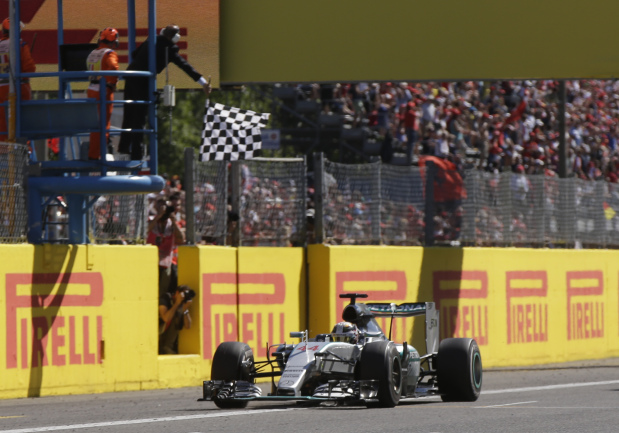
When Lewis Hamilton crossed the line in Monza yesterday afternoon, he completed his 40th Grand Prix victory - a tally that ranks him 5th in the history of the sport for race wins. One place above him is Ferrari's German magician Sebastian Vettel with 41 - tied with Ayrton Senna. One place below Hamilton is the imperious but currently wasted Spaniard Fernando Alonso with 32. 

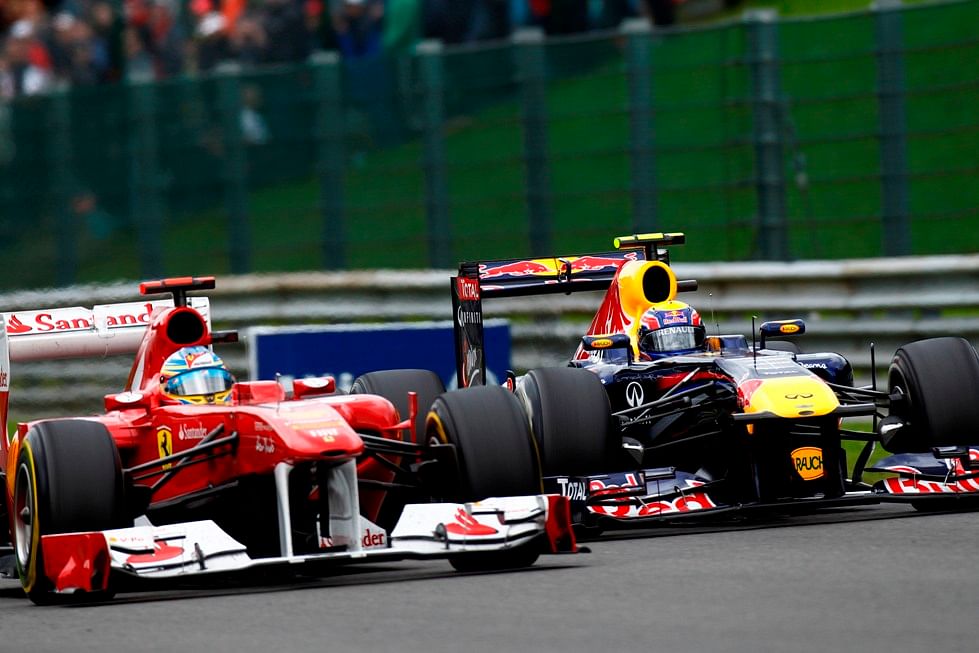
So that's the fourth, fifth and sixth most successful drivers all currently on the race grid, and all with plenty more time to add a caveat of Grand Prix victories to their already bulging records (some may argue that Alonso's light is fading, but it would take a true cynic to deny his ability to seize the opportunity of success when it arises). Beyond these three megastars, former champions Kimi Raikkonen and Jenson Button also continue to plug away in Formula One, while nobody doubts the fantastic talents of Nico Rosberg, Felipe Massa , Valtteri Bottas, Nico Hulkenberg and Daniel Ricciardo.

The best there has been?

Is this the most talented grid in Formula One history? There is definitely quality throughout the paddock, with a mixture of established pros and rising stars dicing it out on track. Some may sneer, and offer the likes of Pastor Maldonado as a rebuttal, but I'm referring to both the quantity of supremely skilled drivers, as well as the greatness by which they are regarded. 

However, it is only fair to say that time will tell. We have five champions on the grid, but one can envisage drivers like Valtteri Bottas and Daniel Ricciardo going on to take the crown in future seasons. Perhaps in ten years people will look back at the current crop and judge a few more of the above names as legends of the sport. With that in mind, let's have a quick look down memory (or in my case, slightly rushed research) lane at some of the other contenders for the most star-studded grids in Formula One history.

1965 - Champion: Jim Clark (beating Graham Hill, Jackie Stewart and Dan Gurney) 

Jim Clark was integral to an iconic time in F1's history.
Let's start exactly half a century ago, a season of undeniably legendary drivers which was ultimately dominated by the Brits. Jim Clark won six races to take his second championship title, which he would inevitably have added to had it not been for his tragic death in 1968. Clark led home his fellow countrymen Graham Hill and Jackie Stewart, the latter of whom made his Formula One debut during this season and cemented what was to come with his first race victory at the Italian Grand Prix. This terrific trio, perhaps, appropriately mirrors the current season's top crop. 

Further down the standings, the list of talented drivers just seems to continue endlessly. 1964 champion John Surtees returned with Ferrari, as well as Jack Brabham who was between his second and third titles. Furthermore, future champion Denny Hulme began his racing career in 1965 with the Brabham team, while another champ-to-be Jochen Rindt had his first full season in F1 in a Cooper. Other noteworthy names include Dan Gurney, Lorenzo Bandini, Jo Bonnier, Jo Siffert and Bruce McLaren. 

Truly, 1965 was a glorious year for F1. It's fair to mention that all seven of the champions listed above would finish in positions 1-7 in the standings for 1966, but 1965 gets the nod here purely for the strength of the entire field. 

1975 - Champion: Niki Lauda (beating Emerson Fittipaldi, Carlos Reutemann and James Hunt)

In an era of legends, it's arguable that Lauda outranks them all.

Ten years later, Formula One has cooked up another delicious batch of brilliance. Niki Lauda's "unbelievable year" saw him cruise to his first world title in a tremendous Ferrari which easily had the upper hand on the rest of the field. Nevertheless, Lauda had to triumph over some fine competitors to capitalise on his advantage. Emerson Fittipaldi was looking for a second consecutive title in his McLaren, and he began the season strongly before car troubles hampered his hopes.

Many observers fancied the chances of Brabham's skilful Argentinean Carlos Reutemann before the beginning of the year. Though never a champion, Reutemann was highly regarded throughout his Formula One career, and was agonisingly close to a title of his own when he missed out by one point in 1981. Brabham's projected dominance never failed to materialise.

This season also included James Hunt's famous victory for the Hesketh team, a performance that gave F1 a premonition of the amazing title-fight to come the following year. Carlos Pace also secured his historic Interlagos win, making this a tremendous year for tremendous stories. Other noteworthy drivers included champions Jody Scheckter, Mario Andretti and Alan Jones, as well as Clay Regazzoni, Jochen Mass, Ronnie Peterson and Jacky Ickx.

1986 - Champion: Alain Prost (beating Nigel Mansell, Nelson Piquet and Ayrton Senna)

Prost lines up against Mansell - whose tyre blowout would hand him the title.

This list couldn't possibly be complete without a season including Senna, Prost, Mansell and Piquet. It's difficult to argue that there has ever been a better top four than this. The proof of Prost's success is in both his statistics (four World Championships and 51 career victories) and the prestigious truth that he was the only driver who could challenge Senna at his most rampant. Nigel Mansell, as well as being a massively popular figure, was setting a new standard for British drivers (his tally of race victories was only recently toppled by Lewis Hamilton) and finished a devastatingly close second following the tyre failure that British fans try so desperately to forget.

Nelson Piquet was undeniably strong and still had a title in him, which he would take the following season. And finally, do we really need to say anything more about Ayrton Senna? Even before his three World Championships, Formula One was under no illusions as to the truly sensational young driver's future. To this day, it's difficult to find any rational motorsport fan who wouldn't include Ayrton Senna as one of the greatest drivers in the sport.

Such strength in these characters alone would warrant inclusion in this list, but this season deserves extra consideration for the addition of champions Keke Rosberg and Alan Jones, and the talents of Stefan Johansson, Gerhard Berger and Michele Alboreto. Perhaps unfairly, this season also gets further preference for the outrageously dramatic title decider in the Australian Grand Prix.

Any more?

Was '97 - with Schumi, Villeneuve, Damon and Mika - worth a shout?


These are just three examples of great eras in Formula One, but I'm sure that you, dear reader, may have other candidates you feel are worthy of mention. So feel free to comment on your pick from the list, or perhaps your own nomination for the greatest grid in F1 history. Go on! I bloody dare you!

Thursday, 20 August 2015

Kimi is Ferrari's Safe Bet

Raikkonen will race for Ferrari in 2016
Ferrari team boss Maurizio Arrivabene seems to be aware that managing Kimi Raikkonen is a game of careful motivation and precise timing. Earlier in the season, the no-nonsense Italian suggested that Raikkonen was already in Ferrari's plans for the future, but that they did not want to offer him a new deal to ensure that complacency would not become an issue.

However, with speculation starting mount up and becoming Ferrari's big elephant in the room, Arrivabene and the team have relented and Raikkonen can guarantee himself one of the most prestigious seats on the grid for the upcoming season. While there may have been some possibility for the much-fancied Valtteri Bottas to slip into the famous red cockpit, the management have either deemed that too risky, too expensive or too soon.

Kimi's form - steady improvement?

Kimi's best result this season was 2nd in Bahrain
Part of the reason the whispers of replacement became murmurs was down to Raikkonen's under-par performances. This was more prominent last season, but it's difficult to ignore that despite the Finn scoring reasonable points all year, his new team-mate Sebastian Vettel has racked up over double his tally. Couple that with Vettel's two race victories, and there is a clear hierarchy in the Ferrari team.

Things came to a head in Austria after Kimi's worst performance of 2015. He qualified 18th and crashed out of the second corner of the race. Nevertheless, the signs that things would be OK for Kimi should have been apparent from Arrivabene's post-race comments, in which he refused to criticise his driver and reassured that the team would be taking a more holistic approach to Raikkonen's performance when deciding if he should remain with the team. Clearly, this sort of encouragement displays Arrivabene's desire to have Raikkonen at the team.

In the final race before the summer break, Raikkonen could have capped off a Ferrari 1-2 had it not been for engine troubles which led to him retiring. The team have mastered the psychology of keeping Kimi at the team, and it's producing increasingly good performances from the Finn.

Seb and Kimi - a match made in heaven

Ferrari have been happy with the positive relationship between their drivers.
In the run-up to the 2015 season there was a lot of debate as to how Vettel would cope with having a former World Champion to contend with as a team-mate. His fiery relationship with Mark Webber, and his mopey persona while Daniel Ricciardo dominated last season, added up to the image that Ferrari's new superstar may be difficult to work with.

Cut to August, and things appear to be appropriately rosy between the duo. Vettel and Raikkonen have built an amicable working relationship that has allowed both of them to score satisfying results across the season. With two former champions in the team, Ferrari will no doubt understand how valuable a commodity it is to have the two working beyond just themselves.

Would it be foolish to cash this in? Bringing in a less experienced driver with the potential to upstage Vettel would definitely make the situation more volatile and could affect results negatively. While Ferrari are just inching their way back into the picture as one of the top teams in the sport, perhaps it would be reckless to bring in a circus of biting retorts and vicious accusations to distract from the excellent progress they are making.

There's no rush

Speculation suggested that Bottas would replace Raikkonen
If this was the final opportunity to pick up some of the biggest talent on the grid, then you could call this decision a bit safe and unadventurous. But with Ferrari choosing to close their seats for 2016, there truly isn't much of an option for best young talent on the grid to move upwards.

Mercedes and Ferrari are probably the two outfits that would hold the most glamour to an upcoming star of F1, but both have confirmed their driver line-ups for next season. Williams and Red Bull are probably next up, and they do have potentially spare seats. However, neither of these teams quite have the same pull as Ferrari, both in current and historical contexts (albeit Williams runs Ferrari close). Arrivabene will feel he can prize any driver away from these teams, and it's easy to imagine that Bottas will want an option in his new Williams contract in preparation for the call from Ferrari in 2017.

The only possible way one of Ferrari's targets could suddenly become unreachable is if they take the unlikely step of joining a team that promises future glory, such as McLaren. However, with the disastrous results that has heralded for Fernando Alonso, it looks unlikely that anyone will take that chance.

Glad to have him

According to the recent GPDA survey (a survey I incomprehensibly analysed here) Kimi Raikkonen is the most popular driver in Formula One. It was quite likely that, had he not been retained by Ferrari, the Finn would have left the sport for good. With that in mind, it's personally relieving to know that Kimi will still be a part of the F1 world.

After all, how can you not love someone who, when asked what they think of Spa-Francorchamps one of the most historically wonderful circuits in F1, replies "It's quite nice".

Tuesday, 28 July 2015

F1's Conflicted Self-Pondering: Pulling apart the GPDA survey

Are fans still in love with F1?


Wasn't the Hungarian Grand Prix a blast? The Battle of Budapest cooked up an unusually enthralling storm, which gave analysts a convenient hook for predictable "Who says F1 is boring?" comments. While there is no denying that the last two races, and indeed the 2015 Championship battle, have been entertaining, this seems like a simplification of the more severe underlying problems that F1 is going through. This great branch of motorsport is trying to answer some tough questions about its future, but how can anyone be sure of the direction it needs to take?

The GPDA (Grand Prix Drivers Association) attempted to find some clarity by conducting an enormous survey into fans' opinions of the state of Formula One. The amount of responses received is admittedly impressive, with over 200,000 people from 194 countries taking part. The results are summarised in a slick document available on the GPDA website, which gives basic data for each questions. By dissecting this further, I think it's possible to find some very interesting information that stretches beyond what the organisation were looking for.

 Crowds continue to turn up in droves for the British GP.

Before looking at the audience which took part, there are some results that are immediately striking. Page 12 details a list of attributes fans associate with F1, both in 2010 and 2015. The top 3 descriptors for F1 in 2010 are 'Competitive, technological and exciting', whereas in 2015 they are 'Expensive, technological and boring'. This is not just a damning verdict on Formula One today, but also a somewhat surprising one. The 2010 season saw a total of 547 overtakes during the entire season (lower than the four following seasons) and, despite a memorable Championship fight, failed to produce any real classic Grands Prix.  It's very odd that fans would be so fond of this period of Grand Prix racing, but clearly there is a feeling that the quality has dropped dramatically.

Sure enough, less than 10% of those surveyed believe that Formula One is healthier than it was 5 years ago. "Healthier" leans more towards the suggestion of F1's current financial state and its future. It makes a lot more sense that fans would have a pessimistic outlook on the sport. In 2010, we had the arrival of Caterham, Virgin and Hispania, as well as Mercedes taking over Ross Brawn's team. It was a counter-boom to the world's troubled economy. Since then, the cracks have slowly covered the stoic face of the sport, with Marussia clinging on as the only surviving member of the new-fangled trio, as well as other teams flirting with the idea of ditching F1. It's only natural to feel an impending sense of dread about F1's next few years as it struggles to compete with its own unsustainable model.

 A less 'healthy' F1 has seen smaller teams struggle to stay in existence.

Now, it's difficult to talk about the rest of the survey without analysing the audience that took part. While it would seem fair to assume that most people answering a questionnaire about F1 on the internet are hardcore Formula One fans, page 8 of the document actually throws some fascinating curveballs. Less than one-in-four people who answered the survey regard Formula One as their favourite sport, and an ambiguous-but-discouraging "over half" watch at least 12 races a season in some form.  These results suggest that the survey wasn't just completed by staunch F1 followers, but quite a few casual fans as well. That's not to say that these are passing fans though, as some of the questions involved do require a base knowledge of the more technical aspects of F1. 

Further to this, the average age of those who responded to the survey is 37. Bearing in mind that this survey was exclusively online, this number is quite high. Is it the case that Formula One has very little appeal to younger fans? Or is this more to do with the sort of person who will complete a survey in general? Either way, these facts should be kept strongly in mind when viewing the rest of the results. These are not all staunch F1 fans, and typically, are the opinions of a low-middle-aged sample.

 F1 - A sport for hardcore and casual fans?

Having evaluated the audience, there are some results that speak volumes. 85% believe that Formula One needs to recruit new fans. This may seem obvious, but compare that to 64% of people believing the same in 2010. Why were we so passive about new fans before? What's changed now? A lot of this probably comes down to the 'health' of the sport being seen as poorer than before, and part of that feeling could be to do with falling viewer numbers. 'Recruiting more fans' is the obvious solution, but how?

Reading further on in the survey gives us an insight into what fans feel needs to be done to help this recruitment process. The top suggestion of what's important to current fans, with 74% 'agreeing', is that rules should be relaxed to allow a great diversity of technology and cars. Other factors seen as important include "the sound of engines", "the power of engines" and "the size and type of engines". Going back to our audience data, it seems worthy to make some sort of amendment here. The audience we're looking at is a mix of hardcore and casuals, but it seems fair to suggest there is a tendency towards technical fanatics when it comes to this particular sample.

Are current engines noisy enough? Some fans don't think so.

Maybe that's not fair. Maybe there really is mass appeal when it comes to the engines and technology, but is this really what we can imagine the prospective casual fan that we are looking to recruit enthusing about while watching a race? Perhaps when attending a Grand Prix, we can envisage casual fans being wowed by the roar of the Formula One engine as a car sweeps past the grandstand, but it seems more likely that a potential F1 viewer is going to watch a few races on TV before shelling out for a race-day ticket. 

For hardcore fans, this matters. Of course it does. And if F1 is looking to recruit more 'hardcore' fans then this is fair. But that's the decision the sport has to make. The benefits of coming to such a conclusion would be that F1 can aim to please its most fanatic viewers, thereby ensuring a core support of devoted fans. However, a sport that has historically thrived on the financial gain of advertising huge brands and reaching big viewer numbers is going to struggle to make that transition and continue to be the pinnacle of motorsport, which 60% of fans currently believe is the case.

 Would bringing in another tyre company improve the sport?

In fairness to those surveyed, the choices given in the 'What's important to you' section of the survey seem pitifully off the mark. There is nothing regarding competition, overtaking, accessibility or driver aids. With these involved in the survey here, this table might have been more reflective of what you would expect to see F1 fans say. Going back to page 13, a section titled "Your Views on F1", 89% of fans answered that they feel Formula One needs to be more competitive. This doesn't really communicate much information though, as it's hard to imagine the fan who doesn't think F1 should be more competitive. 

So what else does this survey indicate that fans want? 80% believe that there should be more than one tyre supplier in Formula One. There is a logic behind this being the most desired change, although it is flawed in some respects. A lot of fans are understandably fed up with Pirelli tyres and want a tyre-war to add another aspect of competition. If we could be sure that this would definitely increase overtaking and general race drama, then this would be a very agreeable concept. However, overtaking was poorest during the tyre-war between Bridgestone and Michelin, and the level of competition during quite a few of those seasons was exceptionally poor. 

Some will argue that allowing companies to develop the best tyres possible will increase the ability for drivers to race at full speed. Is this important to fans? I think so, perhaps a survey question would have helped here, but again none of the survey focussed on an issue that has been discussed quite a lot recently, which is whether or not F1 cars should be going faster. However, considering that fans feel engine specifications are important, and a surprising 60% of fans also backed the reintroduction of refuelling, it seems that a lot of these results are aiming towards an F1 where the cars are faster, which is of course what has been planned. Will a tyre war help along the way? Perhaps it will, but if 89% of fans think F1 should be more competitive, isn't that what we should aim for first?

 Wheel-to-wheel racing: The bread and butter of this great sport.

I'll try to summarise what feels like a mash of ideas. I think this survey gives us a lot of interesting thoughts, but from the very premise missed out on what could have been some more fundamental insights into what makes a Formula One fan tick. I really would like to know whether F1 fans prefer speed or competition, as this seems to be the crossroads we're starting to head towards. Currently we have neither, and of course we want both. But if F1 really does need to recruit new fans, it needs to know what makes those fans interested in the first place. This survey suggests that fans want more speed, faster cars, better engines. 

I've always enjoyed watching British Touring Cars as a casual viewer. I don't watch it for the speed, the cars or the engines. I watch it because it's bloody good fun, and it keeps me coming back. I think that is what F1 needs to be looking for if it's ever going to appeal to the casual viewer in a way that will improve the 'health' of the sport, but there is always the possibility to focus on the hardcore fans. Maybe that is the question that F1 needs to ask itself first: What sort of fans do we want?

You can view the GPDA survey results here.