Showing posts with label european championship. Show all posts

Thursday, 3 September 2015

Iceland in the Ascendency


Iceland fans are celebrating unprecedented success.

With the European Championships expanding from 16 to 24 teams, the qualification campaign for France 2016 seemed unlikely to generate much significant discussion. There were fears that the larger teams would coast into the competition having broken barely a bead of sweat, while Europe's perennial whipping boys would continue to battle against conceding double figures in every tie. The only real drama, it appeared, would be from middling nations scrapping for play-off places.

But a spread of fascinating narratives across the continent has spiced up the intrigue in this deceptively straightforward elimination process. Wales have seized their best opportunity to qualify for a major tournament since 1958, by surprisingly dominating a group containing the much-fancied Belgians. On the flipside, 2004 champions Greece have suffered the indignity of defeats to Faroe Islands, which has summed up a tumultuous qualification campaign in which they are now on their third manager.

Flying, under the radar
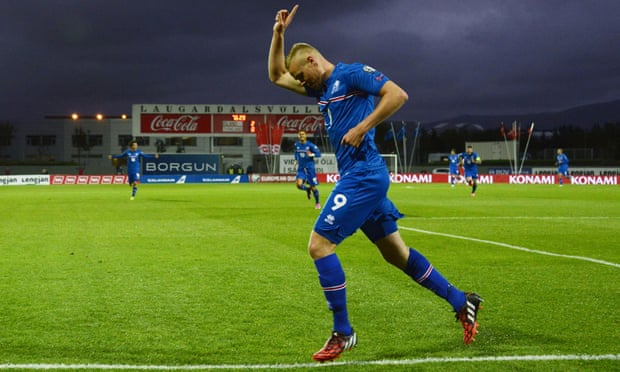
Iceland's diminutive stature provides a stark contrast to their brilliant form.

These are fascinating tales of massively changing fortunes, but while these steal the column inches, the extraordinary events of Group A arguably mark the most significant upset taking place in Europe. Iceland, a nation with the miniscule population of just 300,000 people, could be making their major tournament debut next summer. This is impressive enough, but the manner in which Iceland may qualify is truly astounding.

No-one would have given StrĂ¡karnir okkar much more than a prayer five years ago, and despite a good 2014 World Cup qualification campaign, a tough group kept their hopes similarly watered down. Iceland were pitted against the Netherlands, Czech Republic and Turkey - three strong nations, and even with a play-off place for third, Iceland seemed like just an outside hope. 

Iceland's double Dutch success

As well as victories over Holland, Iceland have triumphed over Turkey and Czech Republic.

Flash forward to today, and Iceland have climbed above all of these teams. With three games to go, Iceland have already assured a play-off place, and have an 8 point cushion for automatic qualification - capable mathematicians will spot that this means just one more victory will propel Iceland into a historic first major tournament.

Amongst Iceland's most impressive performances in the campaign are two victories over the Netherlands. This ought not to be taken lightly - Holland reached the semi-finals of the last World Cup, which included a 5-1 victory over previous champions Spain. Iceland beat them 2-0 at home almost a year ago, capitalising on a laboured performance from the Dutch with two Gylfi Sigurdsson goals. 

However, tonight's 1-0 win at the Amsterdam ArenA displays Iceland's legitimate international pedigree, proving that they are beyond just triumphing over jaded giants. Some sources suggest that Iceland managed to keep 71% of the possession, a ridiculous statistic if true. Neither of these victories were fluke results, but illustrated the culmination of Iceland as a well-oiled machine of a side.

What has changed for Iceland to become sudden heavyweights?

A novel coaching team

Lars Lagerback's arrival has had a monumental impact.

Iceland's ascendency can be traced back to 2011, with the appointment of Lars Lagerback. Lagerback was Sweden manager between 2000 and 2009, during which he led the Swedes to qualify for every major tournament besides the 2010 World Cup. With such an excellent track record, Iceland's appointment of Lagerback is a coup that may have turned the course of the nation's history. 

According to Lagerback, the Icelandic FA didn't set their new manager any specific targets, but he quickly set about changing the mentality of the team. Lagerback focussed on maximising the efficiency of Iceland's players with astute, comprehensive tactical planning. As well as this, he looked to develop a professional, strong and positive attitude from his squad.

His success was almost immediate - it's easy to forget that Iceland were just one victory away from reaching the 2014 World Cup. An impressive campaign saw them finish second to Switzerland, and the (ultimately, and blamelessly, inexperienced) team came up short against Croatia in the play-offs. Despite this gut-wrenchingly close call, the progress Iceland had made was unmistakable. In 2013, the Icelandic FA took the novel approach of promoting Lagerback's assistant manager Heimir Hallgrimsson to joint-head coach. The arc of progress has remained consistent, and Lagerback's considerable achievements may be topped if Iceland can make history.

Star men

Gylfi Sigurdsson's creative flair, set-piece prowess and ability to keep the ball has been vital.

Just as Wales' surge in form can be partly credited to having a star talent in Gareth Bale, Iceland can look to Gylfi Sigurdsson as the talisman for their recent success. Sigurdsson tops the scoring charts in Group A with 5 goals, including three against Holland. Though he may not be an £85million megastar in the same way as Bale, Sigurdsson's value to Iceland is incalculable, and Lagerback has previously reserved special praise for his top attacking-midfielder. 

Though Sigurdsson draws the plaudits for his attacking talent, it should be noted that Iceland's defence has performed just as remarkably. The combined efforts of Ragnar Sigurdsson, Birkir Saevarsson, Ari Skulason and Kari Arnason, along with goalkeeper Hannes Halldorsson, mean that Iceland have conceded just three goals throughout the entire campaign (one of which was an own goal). The combination of capable attacking flair and solid defending has made Iceland an imperious opponent.

Real contenders?

Iceland will reach Euro 2016 - but just how far can they go?

With only one more win required, and home fixtures to Kazakhstan and Latvia still to come, Iceland's qualification is almost assured. A massive bridge will have been crossed, but Iceland won't dwell on simply reaching Euro 2016 - there is plenty of reason to believe that they could go further.
One of the implications of the new 24-team format means that it will be possible to qualify for the knockout fixtures by finishing third in the group stages. Given Iceland's excellent results in qualifying, Lars Lagerback will likely see this as an absolute minimum for the team, and will potentially even eye a quarter-final given the team's penchant for causing upsets.

Iceland's prospects will be brightened by their current world ranking position of 23rd, which should make it likely that they compete in a group free from the 'big nations'. Nevertheless, if Iceland do find themselves in a group of death, Lagerback will have no qualms about attempting to pull off the shock he managed when bringing Sweden into the knockout stages of the 2002 World Cup, eliminating Argentina in the process.

Iceland's story is already a major surprise, but the biggest shock may be yet to come.

Monday, 6 February 2012

A Growing F.A.rce


How does a stuttering shambles turn into a complete circus act? Just consult the England National football team, which has gone from being a rusted piece of heavy machinery to a complete trainwreck. The past week has not only re-emphasised a consistently failing organisation, but cast a new light upon the utter ridiculousness embodied in this turgid mess.

It was following much pressure that John Terry was alleviated from his captain duties last week. Whether or not you agree with this decision is beside the point though; what followed is a striking example of the miscommunication and chaotic management the England team suffers from. Fuzzy puppet Fabio Capello admitted he wasn’t consulted on Terry’s dismissal, nor did he agree with the decision. The FA today bit back by saying that with his words, Capello had committed an act that was in conflict with a contractual agreement. Even the coalition government radiates solidarity more effectively than this.

It’s difficult to understand why, given how drawn out the John Terry incident has become, the FA were not able to consult Capello on this matter before making a decision. Even if Capello had disagreed with the actions, this would have given both sides a chance to explain their position before showing a united front in the public. Instead, we now have the England manager saying that there are team decisions being made with which he is not entirely happy. How a governing body can allow this to happen truly boggles the mind.

The FA have illustrated for a long time that their ability to control the national football team is poor. Of course, the most visceral judgement we’ll make regarding this is our performance in the major tournaments, and over a long period of time this is a fair way of analysing their performance, but of course some managers just don’t fit and sometimes tournaments just don’t go your way. It has to be said though, their managerial choices are rushed and appear to be a constant bow to public pressure, but this isn’t the main issue as to why the FA is failing.

The largest problem is the stunning lack of foresight the FA has when making any sort of decision regarding the manager or the direction of the football team in general. For example, they fell for Capello’s trick to swindle a contract extension out of them before the World Cup. All Capello had to do was drum up some rumours about the possibility he would move, and the FA would gleefully bend over backwards to keep him at the helm. I’m not saying he did do that. Of course, I wouldn’t be allowed to say that. But either way, that extension probably made it financially impossible for Capello to be sacked straight after the World Cup, putting him in a position where there was no pressure to perform (clearly).

But even that doesn’t quite illustrate how poor the FA’s planning is. To try and explain my point, I have to really talk about the last 10 years of England’s history. During that time, we’ve had three different managers. When cuddly Swedish man Sven Goran-Eriksson was in charge, he kept the first eleven pretty much the same throughout his reign, with minor changes when players either retired or new young starlets burst onto the scene. As a man manager and tactician Sven was probably about average, but his focus and consistency with team selections allowed the team to perform moderately well.

 It was during this time when England looked the most likely to win a tournament. After looking quite strong, we lost to Brazil at the World Cup 2002, who went on to win it. We then lost on the dreaded penalties to Portugal in Euro 2004, again after playing some decent football. In 2006 however, Sven’s preferred eleven was starting to look older and Sven himself had become embroiled in scandal. It was at this point the England team started to fall apart, and after a muted performance at the 2006 World Cup the team desperately needed a new direction. Sven was removed, and this was going to be a crucial appointment for the FA to make.

The FA went for bewildered ombrophobe Steve McClaren, who is unfortunately one of the most notorious disaster stories in English management history. It was a massive mistake to appoint somebody who had been a part of Sven’s management team, as this meant McClaren had taken a lot of influence from the Swede and maybe felt pressured to keep using the players that had been so integral in the previous years. As it was, McClaren employed the same ideas that had started to fail for Sven, and the deterioration of the England team this time was so dramatic, McClaren failed to even qualify for the European Championships.

This whole episode was more damaging than you might think. Not only had England embarrassingly failed to qualify for a major tournament, but the development of a team for the World Cup 2010 had been set back two years whilst McClaren fumblingly shuffled the old players around trying to find the best formula. What would have been more useful is if somebody younger, untouched by the old reign and with undeniable potential had taken the job, and had been told by the FA that they should use the Euro 2008 qualifiers as an opportunity to get a team playing well together. That way, England would have optimised their potential for the World Cup 2010, which to almost everyone, is the more important competition and should therefore be prioritised.

It may seem a bit rash, but there’s a lot to be said for team chemistry. You may think it’s a little ineffectual, but when you look at the major successes in international football, you usually find that those players have played in a similar eleven for a long time and have built up an understanding with each other. Just take Spain. That team has a core of players that know each other inside-out, and as a result Spain are one of the most flowing and competent teams on the planet.

England just never get the opportunity to make that fresh start though. We are far too preoccupied with the tournament at hand, that we never anticipate anything beyond it. Let’s be frank – we won’t win Euro 2012. We knew that from the moment our qualifying campaign started. So with this in mind, why didn’t we use this experience as an opportunity to plant the seeds of a new young side that would have to potential to challenge for future World Cups? Sure, we might not have qualified for Euro 2012, but so what? If it’s a team of youngsters learning the ropes the hard way, then we’d be all the better for it in the end.

So anyway, back to bashing the FA. Following the catastrophe that was Steve McClaren’s tenure, the FA decided they would give the national team a different approach and appointed Fabio Capello. This was a good idea, but they made the mistake of employing someone who was already 61, and therefore unlikely to see the team past a couple of tournaments. This also meant that Capello wanted to achieve results straight away, so once again we had a team of players who were hanging over from the last generation so we could achieve more comfortable victories in the qualifiers. The benefits weren’t felt though, as England once again whimpered out of the World Cup and the FA sheepishly tied up Capello’s contract for what would be two more wasted years.

Now we reach today, and what we see is an unmitigated disaster. Not only is the team struggling, but we now have the manager at odds with the FA. A precedent has now been set that the FA can make petty decisions regarding things such as captaincy. And finally, the most likely candidate for the England job once Capello has finished is facing a possible prison sentence. It’s a remarkable mess, and one I fear will only grow unless the FA mark out England’s intentions as a football team and make a decision that will pay dividends, perhaps not immediately, but over time.

Monday, 14 November 2011

The England Mentality Paradox

England 1-0 Spain. I’ll repeat that. England 1-0 Spain. Whenever we get one of these results, where we either beat the champions or give a decent team a good thrashing, there seems only to be two types of reaction from England supporters. The first (and I believe much less frequent) response is to reach a delirium that inspires the fan to spout ridiculous idealistic predictions, such as “WOO WE BEAT SPAIN WE’RE GOING TO WIN THE WORLD CUP” or “Strewth lads, we must be top of the tree if we can beat them fellas”. I get the feeling that the media likes to paint this sort of picture more than the fans though. I think the reactionaries have become more embittered towards the national team over the years.
The second camp is one of downbeat derision, looking to instantly play down every notion of success in case, heaven forbid, we may enjoy a victory. They’ll say things like “Yeah, we won, but we’ve got a long way to go to be up there with Spain” or “Blimey geezers, this ain’t no World Cup we just won, it was a pointless little friendly”. This type of supporter is desperate not to be seen as one of the ‘reactionaries’, and so their first retort is to frantically detract from the win as soon as the final whistle is blown. As time has gone on, this has seemed to become a more and more common response.
It’s funny that we judge our performances as a national team by our potential. We tend to disregard the game itself, and analyse what every performance ‘meant’ for the future and how this bodes for the upcoming tournament. In this case you could say that it comes down to the fact that the game was just a friendly, but we do tend to look far ahead after Qualifiers as well. The pundits after the game are always predicting where each players’ place is in the squad, and whether or not the performance as a whole was worthy of the next major competition.
When did we forget that we can just enjoy a game? I’d be a massive hypocrite for saying we shouldn’t analyse, but surely the overriding emotion from Saturday’s match deserves to be “What a bloody excellent result”? If we were to ignore the Euros completely, we could enjoy the fact that we beat the best team in the world. We weren’t going to outplay them, but through our grit and determination we pulled off a tremendously unexpected result.
If you were to replicate this situation with a club (Let’s say for example, if QPR beat Chelsea), the response would be completely different. There would be no detraction from the result or worrying over not performing and there’d be no analysis of who has earned his place in the team. It’s just a reaction to the game itself, and usually one of total euphoria. It has nothing to do with crazy hype over the team’s potential in the league, and it has nothing to do with holding back or downplaying the result. It is what it is, and fans celebrate it as that. This is how it should be.
Why is the mentality different though? Perhaps it’s to do with the attitude towards the England team these days, which is lukewarm at the very best. Either way, I’d love to relish England victories in the same way I do Portsmouth ones, but inevitably we get bogged down in the analysis, the predictions, the post-amble, the hype, the anxiety. Let’s not have that for once. Let’s just enjoy the fact that England beat the best team on the planet.